


Quick answer: Homeowners insurance costs the most in Florida ($2,677 a year), Louisiana ($2,603) and Texas ($2,397), and the least in Oregon ($893), Utah ($937) and Nevada ($948), against a U.S. average of $1,569, according to the latest NAIC data. On the most popular moving routes, the change is large: moving from Illinois to Florida adds about $1,334 a year in average premium.
Insurance is the moving cost that often surprises buyers after closing, because it isn’t in the moving quote or the mortgage rate. This report uses average premiums for the standard homeowners policy (HO-3) from the National Association of Insurance Commissioners, published by the Insurance Information Institute (Triple-I). We combined them with the largest migration corridors in IRS migration data to show what movers gain or lose.
Last updated: October 23, 2026
Key findings
- Florida has the highest average homeowners premium in the NAIC data at $2,677, 71% above the U.S. average of $1,569.
- The two biggest destination states are both expensive: Florida ($2,677) and Texas ($2,397) rank first and third.
- Moving to Florida raises insurance on every major route: +$1,334 a year from Illinois, +$1,260 from New Jersey, +$1,185 from California and +$1,049 from New York.
- The West is cheap to insure: movers from California to Nevada (−$544), Arizona (−$474) or Washington (−$341) pay less.
- Florida to Georgia saves about $1,022 a year, the largest saving on the routes we checked.
Which states have the most and least expensive home insurance?
The table shows average annual HO-3 premiums for 2022, the latest year in the NAIC data published by Triple-I. HO-3 is the most common homeowners policy. California and Texas figures come from those states’ insurance departments.
| Most expensive | Avg HO-3 premium | Least expensive | Avg HO-3 premium |
|---|---|---|---|
| Florida | $2,677 | Oregon | $893 |
| Louisiana | $2,603 | Utah | $937 |
| Texas | $2,397 | Nevada | $948 |
| Oklahoma | $2,268 | Wisconsin | $957 |
| Colorado | $2,079 | Ohio | $995 |
| Rhode Island | $2,074 | Idaho | $1,002 |
| Mississippi | $1,907 | Arizona | $1,018 |
| Massachusetts | $1,871 | Michigan | $1,056 |
The expensive states share exposure to hurricanes, hail, tornadoes or wildfire, plus high rebuilding costs. The cheapest group is mostly in the West and Upper Midwest. Our climate migration report looks at how disaster risk is shaping where people move.
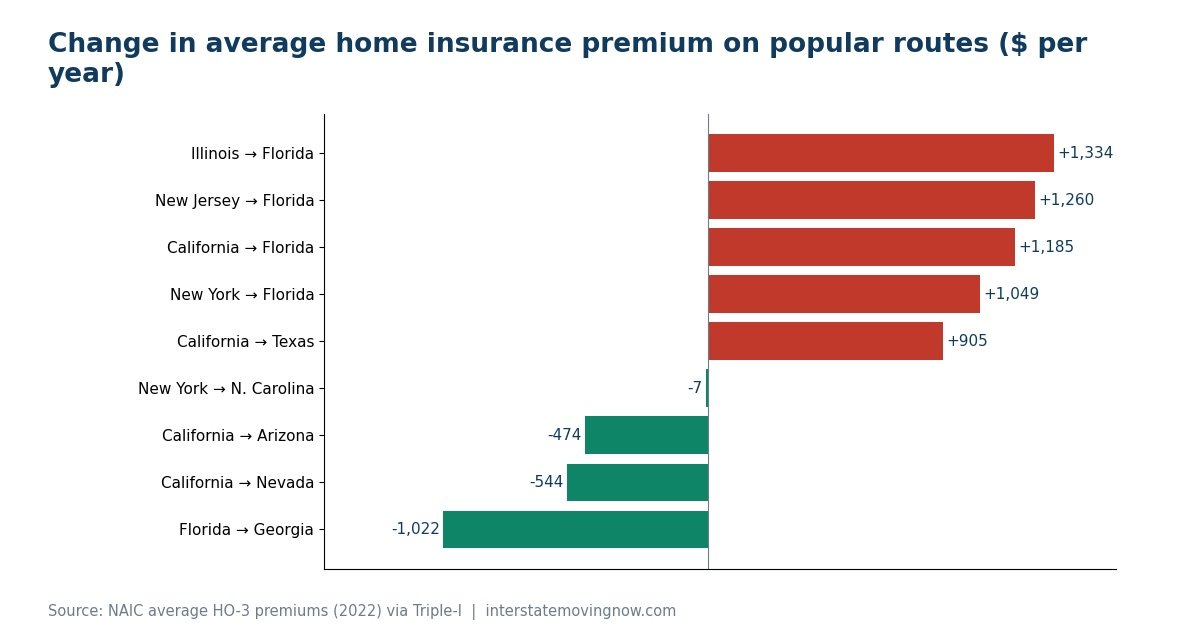
How does home insurance change on popular moving routes?
Our analysis: we compared the average premium at each end of the largest corridors in the IRS 2022–2023 migration data, plus a few popular shorter routes.
| Route | Origin premium | Destination premium | Yearly change |
|---|---|---|---|
| Illinois → Florida | $1,343 | $2,677 | +$1,334 |
| New Jersey → Florida | $1,417 | $2,677 | +$1,260 |
| California → Florida | $1,492 | $2,677 | +$1,185 |
| Illinois → Texas | $1,343 | $2,397 | +$1,054 |
| New York → Florida | $1,628 | $2,677 | +$1,049 |
| California → Texas | $1,492 | $2,397 | +$905 |
| Massachusetts → Florida | $1,871 | $2,677 | +$806 |
| New York → North Carolina | $1,628 | $1,621 | −$7 |
| New York → South Carolina | $1,628 | $1,571 | −$57 |
| New York → Tennessee | $1,628 | $1,492 | −$136 |
| California → Washington | $1,492 | $1,151 | −$341 |
| California → Arizona | $1,492 | $1,018 | −$474 |
| California → Nevada | $1,492 | $948 | −$544 |
| Florida → Georgia | $2,677 | $1,655 | −$1,022 |
The pattern is clear. Routes into Florida and Texas add $800 to $1,300 a year in average premium. Routes into the Carolinas and Tennessee are roughly neutral. Routes from California to its western neighbors and from Florida to Georgia save money. For most movers to Florida, the higher insurance bill takes back a meaningful part of the income tax saving covered in our no-income-tax states report.
How fast have home insurance premiums been rising?
Quickly. In the same NAIC series, the U.S. average HO-3 premium rose 7.6% in 2021 and 11.2% in 2022, to $1,569. A decade earlier, in 2013, it was $1,096, so the national average climbed about 43% in nine years. Renters insurance moved the other way: the average renters premium fell from $188 in 2013 to $171 in 2022.
What does renters insurance cost by state?
Renters insurance is cheap everywhere compared with homeowners coverage, but it still varies. In the 2022 NAIC data, Mississippi ($262), Louisiana ($243), Alabama ($219), Oklahoma ($216) and Texas ($199) had the highest average renters premiums, and North Dakota ($123), Wisconsin ($141) and Wyoming ($142) the lowest. Popular destinations sit in the middle: Florida $181, South Carolina $186, Tennessee $187, Nevada $174, North Carolina $170 and Arizona $163. If you plan to rent first, as many movers do, a renters policy is one of the smallest new bills you’ll take on; see our rent in top moving destinations report for the bigger one.
Why are these numbers a floor, not a forecast?
The NAIC averages are for 2022 and cover all HO-3 policies in a state, including older homes with long-standing coverage. Premiums for new policies have risen in many states since then, especially where insurers have raised rates or limited new business after disasters. Coastal homes, older roofs and homes in wildfire zones can cost several times the state average. Use the table to compare states, then get real quotes for the exact address before you sign a purchase contract.
How to price insurance before an interstate move
- Get two or three homeowners quotes for the specific address during your inspection period, not after closing.
- Ask about the separate wind or hurricane deductible in coastal states, often a percentage of the dwelling value rather than a flat amount.
- Check whether the home is in a flood zone: standard homeowners policies don’t cover flood.
- Ask for a roof age and four-point inspection on older homes, which many insurers require in high-risk states.
- Update auto insurance too: you generally need a policy written for your new state once you register your car there; see our guide to transferring your license and registration.
Your moving company’s valuation coverage is separate from homeowners insurance; our moving insurance and valuation report explains how it works.
Methodology and sources
Premiums are average annual HO-3 homeowners premiums by state for 2022 from the NAIC, as published by Triple-I (retrieved October 23, 2026); California and Texas data come from the California Department of Insurance and the Texas Department of Insurance. Corridors come from the IRS SOI 2022–2023 migration data. Yearly changes are our calculations (destination average minus origin average). Limitations: averages are statewide and two to three years old, and they don’t reflect your home’s age, location, coverage limits or deductibles.
FAQ
Which state has the most expensive homeowners insurance?
Florida, at an average HO-3 premium of $2,677 a year in the latest NAIC data, followed by Louisiana at $2,603 and Texas at $2,397.
Which state has the cheapest homeowners insurance?
Oregon, at $893 a year on average, followed by Utah ($937) and Nevada ($948), according to NAIC data published by Triple-I.
Will my home insurance go up if I move to Florida?
Almost certainly, if you come from the Northeast, Midwest or California. Average premiums are $800 to $1,300 a year higher in Florida than in those states, and coastal homes cost more than the state average.
Is home insurance cheaper in Georgia than in Florida?
Yes. Georgia’s average HO-3 premium was $1,655 against Florida’s $2,677, about $1,022 a year less.







No Comments